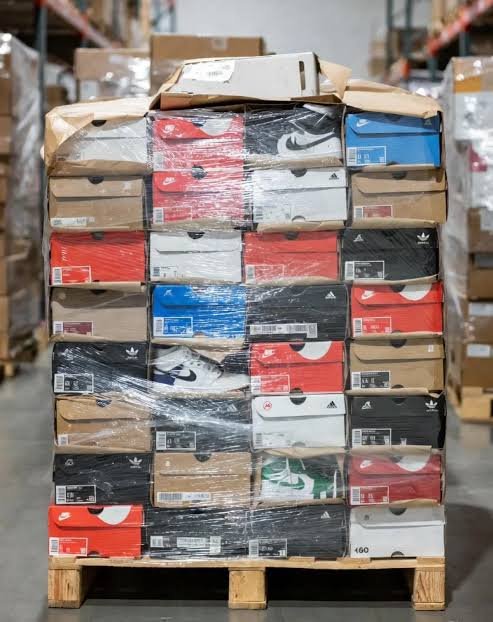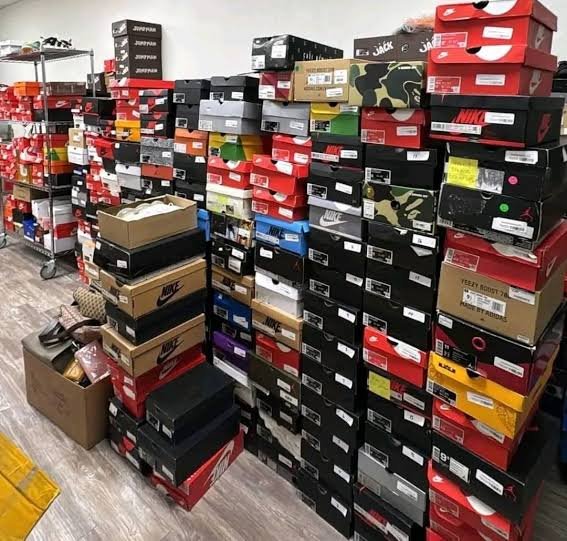

It’s the first real buying decision every footwear reseller faces: Nike pallets vs mixed shoe pallets. One is a single-brand load where every pair has a recognisable name and a searchable resale price. The other is a lucky dip of high-street brands, own-label fashion shoes and the occasional branded gem — cheaper to buy, harder to price.
Both can make money. We’ve supplied hundreds of each to UK resellers, and the honest answer is that they suit different sellers, different channels and different appetites for work. Here’s the full head-to-head — with the maths that actually decides it.
What You’re Actually Buying
A Nike pallet is single-brand: 40–100 pairs of boxed overstock, returns and open-box stock, weighted toward the styles everyone searches for — Air Force 1, Air Max, Dunk, Jordan 1, everyday runners. Per-pair cost typically runs £10–£15 on a £500–£900 pallet.
A mixed shoe pallet is multi-brand and multi-category: trainers, heels, boots, sandals and kids’ shoes from dozens of brands, typically 100–200 pairs at £3–£8 per pair. Brands range from high-street names you can price in seconds to own-label lines with no resale history at all.
The British Footwear Association estimates the UK footwear market at billions of pairs a year — and liquidation stock flows from every corner of it. Your job as a buyer is picking the corner where you can price fastest and sell fastest.
Head-to-Head: Nike Pallets vs Mixed Shoe Pallets
| Factor | Nike Pallet | Mixed Shoe Pallet |
|---|
| Typical cost | £500–£900 (40–100 pairs) | £400–£800 (100–200 pairs) |
| Cost per pair | £10–£15 | £3–£8 |
| Average resale per pair | £25–£55 | £8–£25 |
| Pricing effort | Fast — search the style code | Slow — many brands need research |
| Sell-through speed | Days for common sizes | Weeks to months |
| Dead-stock risk | Low (if graded) | Moderate to high |
| Counterfeit risk | Real — authentication required | Minimal |
| Listing workload | ~40–100 listings | ~100–200 listings |
The Hidden Cost: Time Per Pair
The Nike pallets vs mixed shoe pallets debate usually ignores the one resource you can’t buy more of: your hours.
Every pair you sell needs inspecting, photographing, listing, packing and posting. On a Nike pallet that’s 60–100 pairs; on a mixed pallet it’s 100–200 pairs for less total revenue. Worse, mixed-stock listings take longer to create — a Nike listing is a style-code search and a price check, while an obscure own-label heel needs original research to price at all.
Budget the time honestly: a Nike pallet typically takes 15–20 hours to process end to end. A 150-pair mixed load takes 30–40 hours. Divide your profit by your hours and the Nike pallet often pays £60+ per hour of your work while the mixed pallet pays closer to £20. Per-pair margin can lie; per-hour margin doesn’t.
Size Curves: The Quiet Difference
One more asymmetry worth knowing. Nike pallet stock tends to follow retail size curves — heavy on UK 7–10 men’s and 4–7 women’s, which are exactly the sizes that sell fastest online. Mixed pallets are often size-sorted leftovers, which is a polite way of saying they skew toward the fringe sizes the original retailer couldn’t shift.
Always ask your supplier how a mixed load was assembled. A mixed pallet built from full size runs sells through fine; one built from leftover sizes will leave you with a permanent rail of UK 2s and 13s.
The Margin Maths, Side by Side
Take two £700 pallets and run the numbers honestly.
Nike pallet — 60 pairs at ~£11.70 each:
- 30 boxed pairs × £55 = £1,650
- 20 quality returns × £35 = £700
- 10 odds/damaged × £8 = £80
- Gross ~£2,430 → net after fees/postage ~£1,900–£2,000 → profit ~£1,200
Mixed shoe pallet — 150 pairs at ~£4.70 each:
- 20 branded finds × £25 = £500
- 80 mid-tier pairs × £12 = £960
- 50 slow/budget pairs × £5 = £250
- Gross ~£1,710 → net after fees/postage ~£1,350–£1,450 → profit ~£650–£750
Same money in, but the Nike pallet returns roughly 60–70% more profit — on less than half the listing work. That’s the pattern we see across every footwear load, and it mirrors the wider pallet maths in our toy pallets vs Amazon return pallets comparison: branded, searchable stock beats volume stock on both profit and time.
Why Nike Wins on Speed (and Why That Matters More Than Margin)
Margin on paper isn’t margin in the bank. A mixed pallet’s £700 profit assumes all 150 pairs eventually sell — in practice, the bottom third sits for months, and slow stock costs you storage space, listing fees and cash you can’t reinvest.
Nike stock turns over fast enough that you can recycle the same £700 into a new pallet every 4–6 weeks. Run that cycle six times and the compounding is obvious: the same starting capital produces £6,000–£7,000 of cumulative profit on Nike loads versus perhaps £3,000 on mixed loads that tie money up twice as long.
Our are Nike liquidation pallets worth buying guide breaks down exactly why the style-and-size curve drives that speed.
Where Mixed Shoe Pallets Fight Back
To be fair, mixed loads win in three situations:
- Car boot and market sellers. A £3 pair of fashion shoes that sells for £10 cash in hand is a 230% return — no fees, no postage, no photos. If your main channel is a Saturday pitch, volume beats brand.
- Bulk and export buyers. Selling job lots to market traders and exporters rewards volume, and a mixed pallet feeds that channel beautifully.
- Risk spread. A mixed pallet has no authentication homework and no single-brand risk. If fakes worry you, our how to spot fake Nike trainers guide solves that for Nike — but mixed stock sidesteps it entirely.
Many experienced resellers run both: Nike pallets for the online money, mixed pallets to feed car boots and bulk buyers. That’s a portfolio, not a compromise.
The Beginner’s Verdict
For most online-first sellers, the Nike pallets vs mixed shoe pallets question resolves quickly: if you’re buying your first pallet and your plan is eBay, Vinted or Depop, start with Nike. The pricing is searchable, the demand is proven, the mistakes are cheaper, and one pallet teaches you the whole game — grading, listing, dispatch, channel fees. Add mixed loads later, once you know which channels you actually enjoy feeding.
Whichever route you take, the channel split matters as much as the pallet — our where to sell liquidation Nike trainers UK guide maps every stock tier to its best outlet, and the principles carry straight over to mixed footwear.
Stock Up: Both Options, One Supplier
Team Nike? Browse our current Nike liquidation pallets UK, Nike shoes liquidation pallets UK and Nike shoes pallets for sale UK. Team mixed? See the mixed sneakers pallets UK, wholesale shoes & trainers pallets UK and ladies mixed shoes pallets UK loads. Can’t decide? Contact our trade desk — tell us your channels and budget, and we’ll tell you honestly which of this week’s loads fits. New to pallets altogether? Start with the wholesale shoes pallets UK guide and how to buy wholesale pallets in the UK.
FAQs: Nike Pallets vs Mixed Shoe Pallets
Are Nike pallets more profitable than mixed shoe pallets?
Typically yes. On identical spend, a graded Nike pallet returns roughly 60–70% more net profit than a mixed shoe pallet, with less than half the listing work — because every pair has searchable demand and a known resale price.
How many pairs are in a Nike pallet vs a mixed shoe pallet?
Nike pallets usually carry 40–100 pairs at £10–£15 per pair. Mixed shoe pallets carry 100–200 pairs at £3–£8 per pair, spanning trainers, heels, boots and kids’ shoes from dozens of brands.
Which is better for beginners — Nike or mixed shoe pallets?
For online reselling, Nike: pricing is searchable, demand is constant and the feedback loop is fast. For car boot and market trading, mixed pallets often suit better because cheap volume stock sells well face-to-face at £5–£15 a pair.
What are the risks of Nike pallets compared to mixed pallets?
Nike pallets carry counterfeit risk, so every pair needs authentication before listing. Mixed pallets carry dead-stock risk instead — own-label and obscure-brand shoes can sit unsold for months. Neither risk is fatal; they just need different management.
Can I buy Nike and mixed shoe pallets together?
Yes — many resellers run both deliberately: Nike pallets feed online channels where brand demand lives, while mixed pallets feed car boots, markets and bulk buyers. Starting with one of each teaches you which model fits your time and channels.